Parsa Ara | Independent health services research
Portfolio date: September 5, 2026
Analysis and data retrieval: October 20, 2026
Portfolio date: September 5, 2026
Analysis and data retrieval: October 20, 2026
The question
When anticipated staffing requirements disappear, do nursing homes reverse their investments in nursing care? The federal reversal offers a compelling research question, but its timing prevents a simple before-and-after causal interpretation.
What changed
CMS finalized numerical staffing floors and 24/7 RN coverage in April 2024, with phased deadlines. A federal court vacated those provisions on April 7, 2025. July 2025 legislation then blocked implementation through September 2034. The formal repeal took effect February 2, 2026. These were overlapping changes to anticipated requirements, not the sudden removal of a fully implemented nationwide floor. [1-3]
What the data show
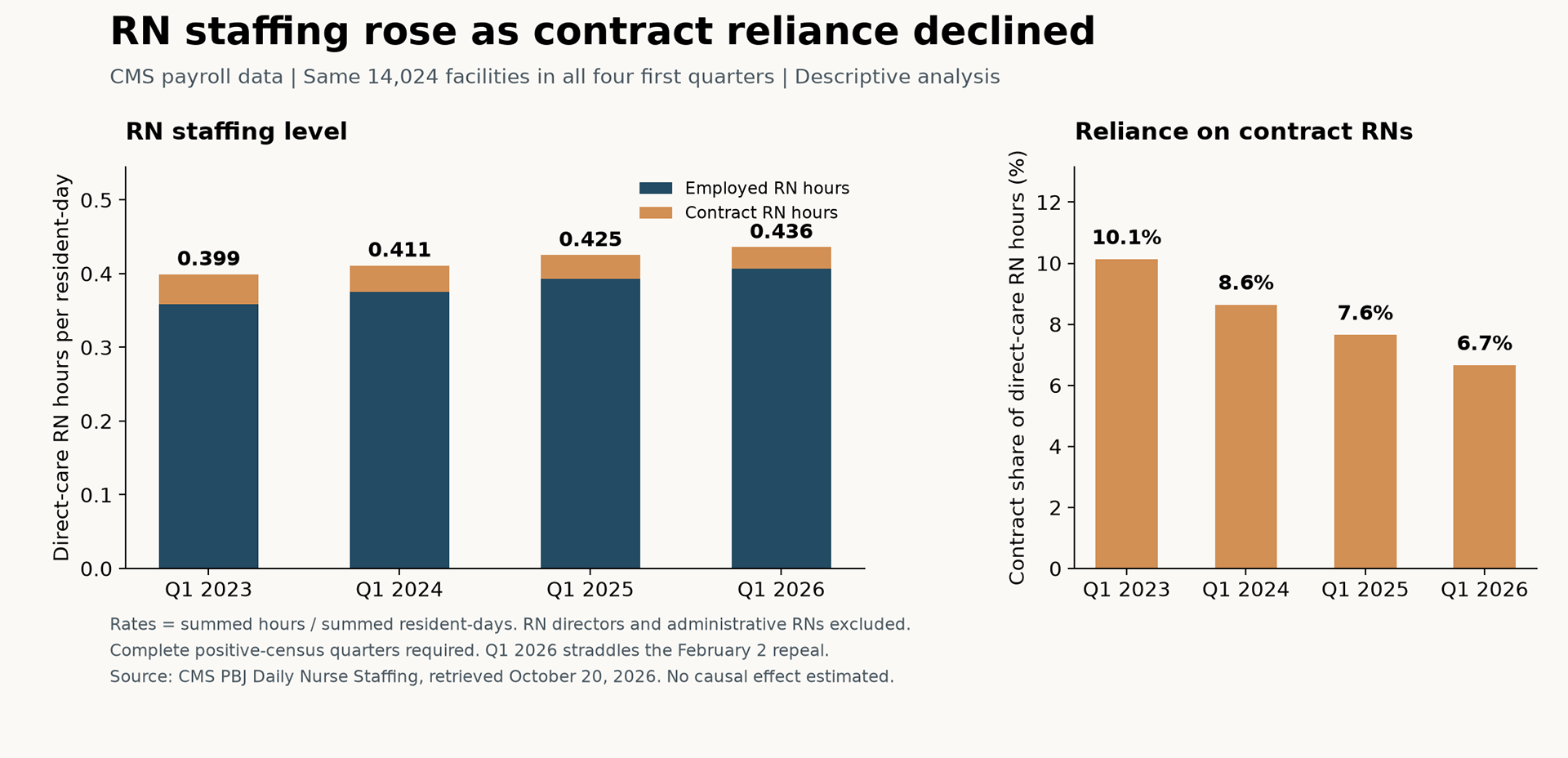
Across 14,024 nursing homes with complete first-quarter observations in 2023, 2024, 2025 and 2026, reported direct-care RN hours rose from 0.399 to 0.436 hours per resident-day. Between Q1 2025 and Q1 2026, RN hours increased 2.5%, employed RN hours increased 3.6%, and contract RN hours fell 10.8%. Contract staffing declined from 7.6% to 6.7% of direct-care RN hours. [4]
How this was measured
The balanced panel contains 5,062,664 facility-days. Rates divide total reported hours by total resident-days, with facilities linked by CMS Certification Number. All four quarters must have complete, valid daily observations and positive census. Direct-care RN means the PBJ RN reporting category, excluding directors of nursing and administrative RNs. Paid hours do not measure bedside contact or continuous RN coverage. These rates cannot establish compliance with the federal 0.55 RN standard.
What the result means
The snapshots do not show a broad national decline in RN staffing. Employed RN growth and falling contract reliance are consistent with a changing staffing mix. They cannot establish what would have happened without the policy reversal. Q1 2026 straddles the effective repeal date. Facilities could have increased staffing even more under continued federal pressure.
Financial effects: capacity versus cost
The measured change was +0.0142 employed RN hours and -0.0035 contract RN hours per resident-day. PBJ records hours, not wages or agency bills. Holding hourly costs constant, the modeled change in RN spending is 0.014197 times the employed hourly cost minus 0.003509 times the agency hourly cost, per resident-day.
An illustrative operating scenario
At an assumed loaded employed cost of $60/hour and an assumed agency bill rate of $90/hour, the observed staffing mix implies +$0.54 per resident-day. At 100 occupied beds for 365 days, that is approximately +$19,564 annually. This is an annualized scenario, not measured annual spending. Additional total RN hours cost about $23,406; reduced agency premiums offset about $3,842 under these assumptions.
The break-even question
Agency rates would need to exceed loaded employed costs by approximately 4.05 times for this specific hours change to reduce modeled total RN spending. Lower contract use can reduce dependence on premium labor while total spending still rises. Wage changes, hiring costs, occupancy, benefits assumptions and differences in patient acuity could alter the result. We do not estimate margins, reimbursement changes or hospital savings.

The next study
Test whether facilities with larger staffing deficits before the September 2023 proposal experienced weaker subsequent RN growth, especially where state rules offered less protection. Assemble every quarter, code state requirements by staffing role and effective date, and distinguish the court decision, legislation and formal repeal. A facility and state-by-quarter fixed-effects design should include baseline-gap-by-time terms, pretrend checks and sensitivity to regression to the mean. This is a proposed design, not an estimated policy effect.
Clinical outcomes and limits
The panel covers all nursing home residents, not only post-acute Medicare patients. It excludes incomplete facilities, entrants and closures. Acuity changes and staffing reporting errors remain possible. Results persist with fixed 2023 facility weights, facility medians and broader RN categories. Published research links daily staffing patterns with hospital transfers, but timing and clinical context matter. [5] Patient-level recovery and rehospitalization would require an additional outcome dataset and appropriate observation windows.
Questions left open
Did low-staffed facilities stop expanding rather than cut hours? Did state rules preserve investments? Does replacing agency labor improve continuity? Are weekends and financially distressed homes exceptions to the national pattern? How do staffing changes affect recovery, transfers and the total cost of care?
High-level takeaway
The strongest current evidence is a staffing composition shift, not a demonstrated effect of repeal. Nursing homes in this complete-observation cohort reported more RN hours and less contract reliance. Financially, that combination may represent investment in employed capacity rather than immediate cost savings. The causal and clinical questions remain open.
Five sources